
MAPLE LEAF PRO Wrestling
OH CANADA! The History of the Maple Leaf on TV

This July, MAPLE LEAF PRO Wrestling makes its debut across the nation on Canada’s Sports Leader, TSN, with the launch of MLP MAYHEM! It brings Canadian professional wrestling back to the forefront of the global wrestling landscape, restoring a tradition of professional wrestling on Canadian televisions, produced by Canadians and starring Canadians. With the arrival of MLP MAYHEM, here’s a short look at the history of the Maple Leaf on television!

By the dawn of the 1950s, Frank Tunney had established himself as the lord of Southwestern Ontario as far as professional wrestling was concerned, and he’d earned the admiration and respect of his peers within the industry. “A quiet spoken man for all his six foot, (Frank) Tunney discusses wrestling with the academic air of an investment counselor,” wrote Victor Koby in a November 24, 1951 article for The National Post on the booming business of pro wrestling. “Only a droll sense of humour, a cluttered office which boasts a stuffed owl, and a penchant for technicolour ties and checked sports jackets throw light on his profession.” Koby estimated “1.5 million admissions are sold every year at an average of $1 apiece. Some 308,000 Toronto fans packed into the million-dollar Maple Leaf Gardens alone, last year.” Wrestling was becoming a big money industry and Toronto – alongside Eddie Quinn’s Montreal territory – had become the mecca for professional wrestling in Canada. Vancouver and Calgary were both running successfully as well, but neither could match the glitz and glamour of the bright lights, big city of Toronto and Montreal.
Since television wrestling began in the late 1940s, the Toronto area had managed to get it on their own television sets, but it had always been syndicated programming from American markets. That all changed in the fall of 1953 when CBLT, the local CBC station, began airing Wrestling From Maple Leaf Gardens. The program featured top matches filmed from Frank Tunney’s Thursday night escapades and helped make the Toronto stars into TV stars like many of their American counterparts. While Foster Hewitt had brought the matches to life with his radio broadcasts of the main events in the 1930s for Jack Corcoran, now having the live footage of the grapplers to witness in your own home only made Tunney’s cast of characters even larger than life.
“The appearance of wrestling on Canadian television opened up new possibilities,” wrote Gary Howard in The Rassler From Renfrew: Larry Kasaboski and the Northland Wrestling Enterprises. “The Canadian Broadcasting Corporation began televising taped wrestling shows on its affiliated stations across the country. The shows originated from Toronto and were cheap to produce, which fit the network’s low programming budget. Just as in the States, wrestlers became instant television stars.” And no stars were bigger than those who appeared for Frank Tunney at Maple Leaf Gardens, where the wrestling was filmed. Tunney soon began to field offers from promoters around the province and the country to use his stars like Whipper Billy Watson, Gene Kiniski, Fred Atkins, and Lord Athol Layton to name a few.
In the fall of 1959, pro wrestling in Canada nearly fell due to a loophole in a new regulation from the Board of Broadcast Governors aimed at American game shows. With a rising concern that many of the game shows being broadcast on Canadian TV were rigged for results, they introduced a new ruling that programs with fixed results were to be banned from Canadian television. This, of course, led many to wonder how professional wrestling would fare under more serious scrutiny, should the Board decide to look into the match-making of the old grunt and groan game. In an article entitled “Hands Off TV Rasslin’” from November 19, 1959, The Toronto Star plead their case to leave pro wrestling well alone:
After all, professional wrestling is not a sports contest. It is pure theatre.
Those cauliflowered titans are magnificent thespians, virtuoso performers who could make even Nathan Cohen [Toronto Star Theatre critic] beam with ecstatic appreciation. Those grunts, those groans, those faces contorted in pain, the tangles of muscled limbs and the flash of a behemoth spinning through space – someone should assure the BBG it’s part of an act which is fully understood by spectators and participants alike.
Each bout is a morality play, portraying the eternal conflict between Good and Evil, and replete with a hero and a villain. In Homeric dramas of courage and daring, Good (the hero) usually triumphs over Evil (the villain).
So why object to a rehearsed victor in these carefully staged dramas? To demand real wrestling, with the best contestant winning, would ruin the show. It would make as much sense as requiring that in each TV production of Hamlet the final duel be “honest”, with the best swordsman the victor. Or to suggest that in TV westerns, the marshal and the villain should shoot it out with live bullets and may the quickest man on the draw win.
Down with all censorship of the arts!
When asked his thoughts on the subject in an interview with The Toronto Star’s Jim Proudfoot in the same day’s newspaper, Gene Kiniski stated that “This honesty thing has gone so far I expect they’ll start investigating Santa Claus to see if he’s on the level.” Thankfully, days later on Close Up with Pierre Burton on the CBC, Dr. Andrew Stewart, chairman of the Board of Broadcast Governors, issued his support of pro wrestling, and the sport was waived of being part of the clampdown on fixed result programming.
1961 would see the peak of television for Frank Tunney up to that point. In an interview in 1968, Tunney recalled that in the fall of 1961, Wrestling From Maple Leaf Gardens was drawing 173,000 viewers on local television, while the Toronto Maple Leafs were drawing just over 172,000. In 1962, Wrestling From Maple Leaf Gardens switched stations, heading from CBC’s CBLT to CTV’s CFTO, Channel 9 in Toronto. “Late last fall,” wrote The Toronto Star’s Milt Dunnell in his August 30, 1962 edition of his Speaking on Sport column, “a Neilsen rating for CFTO, which runs studio wrestling shows, indicated that grunt and groan was slightly ahead of NHL hockey.” It moved from Thursday to Saturday at 5pm, and utilized studio wrestling at the CFTO studios, hosted by Lord Athol Layton. While television was saved, the fact it was no longer on CBC meant that wrestling from Maple Leaf Gardens was no longer a national broadcast, but now relegated to the territorial boundaries of the Toronto area. But by 1966, CFTO pulled the plug. Wrestling was waning in its viewership, and CFTO opted to move on from the seemingly dying sport. How the mighty had fallen.
By 1966, wrestling was starting to suffer a decline. Oversaturation on television was largely blamed, but perhaps holding on to older stars at the expense of younger or newer faces also played a role in it. But Red Fisher had a different thought when writing his column in The Montreal Star on March 29, 1966. “It’s no rap against Tunney, but it’s easy to remember the days when the promoters of an important heavyweight match were almost as important and well-known as the fighters themselves,” Fisher wrote. “They employed shills and hucksters, but in the final analysis the promoters were the imaginative men who somehow managed to squeeze the last droplet of colour into the product they sold. Now, television people and front men and lawyers have taken over. People like Tunney, the licensed promoter, are called only when their signature is needed.”
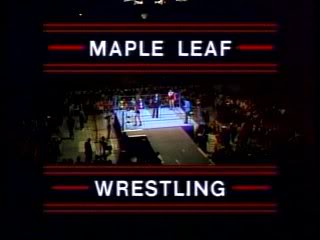
But in 1968, a television station in Hamilton, Ontario, CHCH Channel 11, opted to pick up a new program from Frank Tunney’s stars, that would combine studio wrestling with footage from Maple Leaf Gardens. The studio would accommodate 150 fans in the audience for the special matches that would be taped exclusively for the TV broadcast, with host Lord Athol Layton and special commentator, Whipper Billy Watson. It would start the tradition of the show that would ultimately become known as Maple Leaf Wrestling. Norm Marshall, the CHCH Sports Director, backed up his station’s acquisition of the show in the same 1968 interview for The Toronto Star. Now positioned on Saturday afternoon, it was drawing 115,000 viewers in the CHCH region, a decent number for a weekend day slot. “It isn’t limited to lower mentality types,” Marshall said. “There’s a little of the Roman in a lot of us and we like to watch the gladiators. Wrestling is kidding on the square.”
Maple Leaf Wrestling became the gold standard of Canadian professional wrestling, where stars from the WWWF, AWA, and NWA came to fight alongside the best of the Canadian professional wrestling circuit, until its acquisition by the WWF in 1984, ending a fifty-plus year of Canadian excellence on TV.
Now, with the debut of MLP MAYHEM on TSN, Canadian professional wrestling returns to the television screen, broadcasting from coast to coast to show the world why Canada still matters in the world of pro wrestling!